Dubship I – Infinite Loop
This webpage hosts supporting material for a funding application for our project ‘Dubship I – Infinite Loop’.
Project description
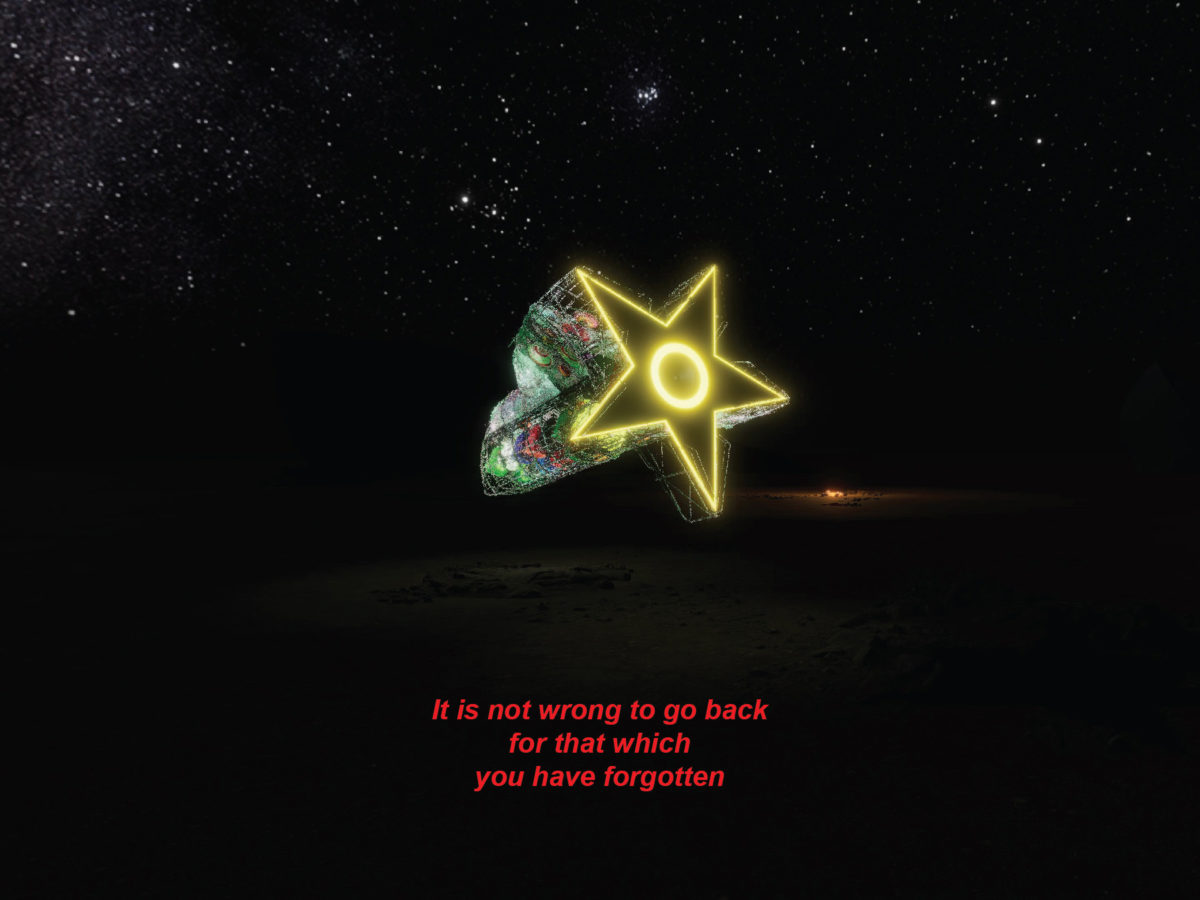
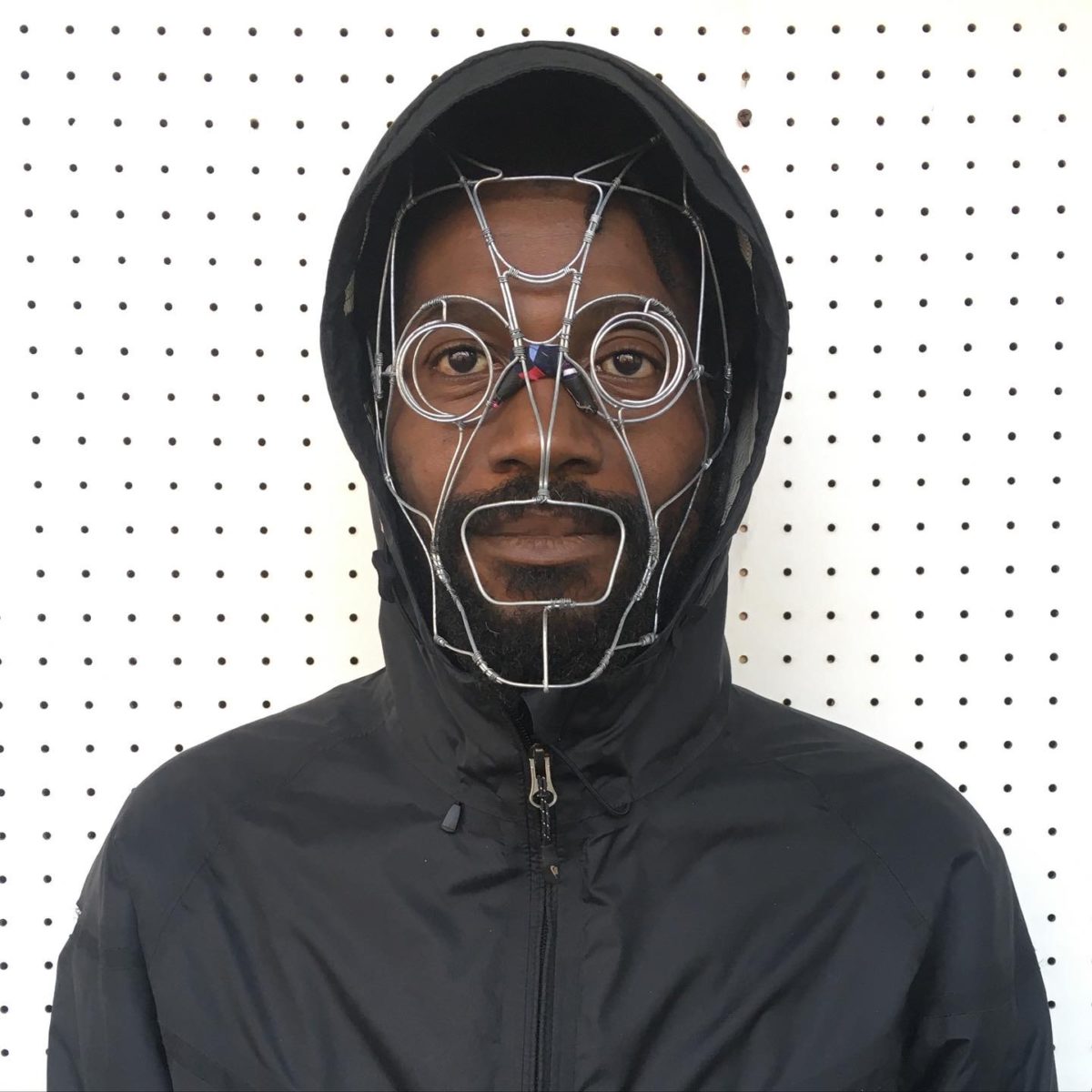
‘Dubship I – Infinite Loop’ is an immersive narrative experience in an online social Virtual Reality world, ‘Digi-Dub Club’, on the VRChat platform. Entering the world, you find yourself with others in a night-time desert landscape, under a canopy of stars, where a fire burns. By its flickering light, a masked figure beckons, and the story begins: moving between the launch of the first ship in the Black Star Line shipping company a century ago – its project to return the descendants of African slaves from the US and Caribbean to Africa; through the Line’s memorialisation in dub music, which created virtual sonic spaces to transport diasporic dancers in Jamaica to a remembered homeland; to Afrofuturist imagining of an interplanetary spaceship to seed new societies, the Black Starliner, launched a hundred years into our future.
The story is told using techniques from the contemporary Nyauist masked dance tradition of Malawi, in which a performer weaves together past, present and future as they assume a range of characters. They summon visions from the stories: a ghost-ship from the desert, its prow ploughing through the sands; or a spaceship from over the horizon, its silhouette blacking out the stars. At the centre of the world is an animated 3D scan of the present-day sculpture ‘Dubship I – Black Starliner’, a large-scale music-making spaceship sculpture launched at Africa’s largest contemporary art museum, the Zeitz MOCAA, in 2019, with funding from the National Arts Council of South Africa. ‘Digi-Dub Club’ extended the work into VR social space in 2020, with the support of the Africa Culture Fund. In 2022, ‘Dubship I – Expanded Universe’ was exhibited in one of the main halls of the Dakar Biennial of Contemporary African Art. ‘Dubship I – Infinite Loop’ is the story we hinted at there – and now want to tell.
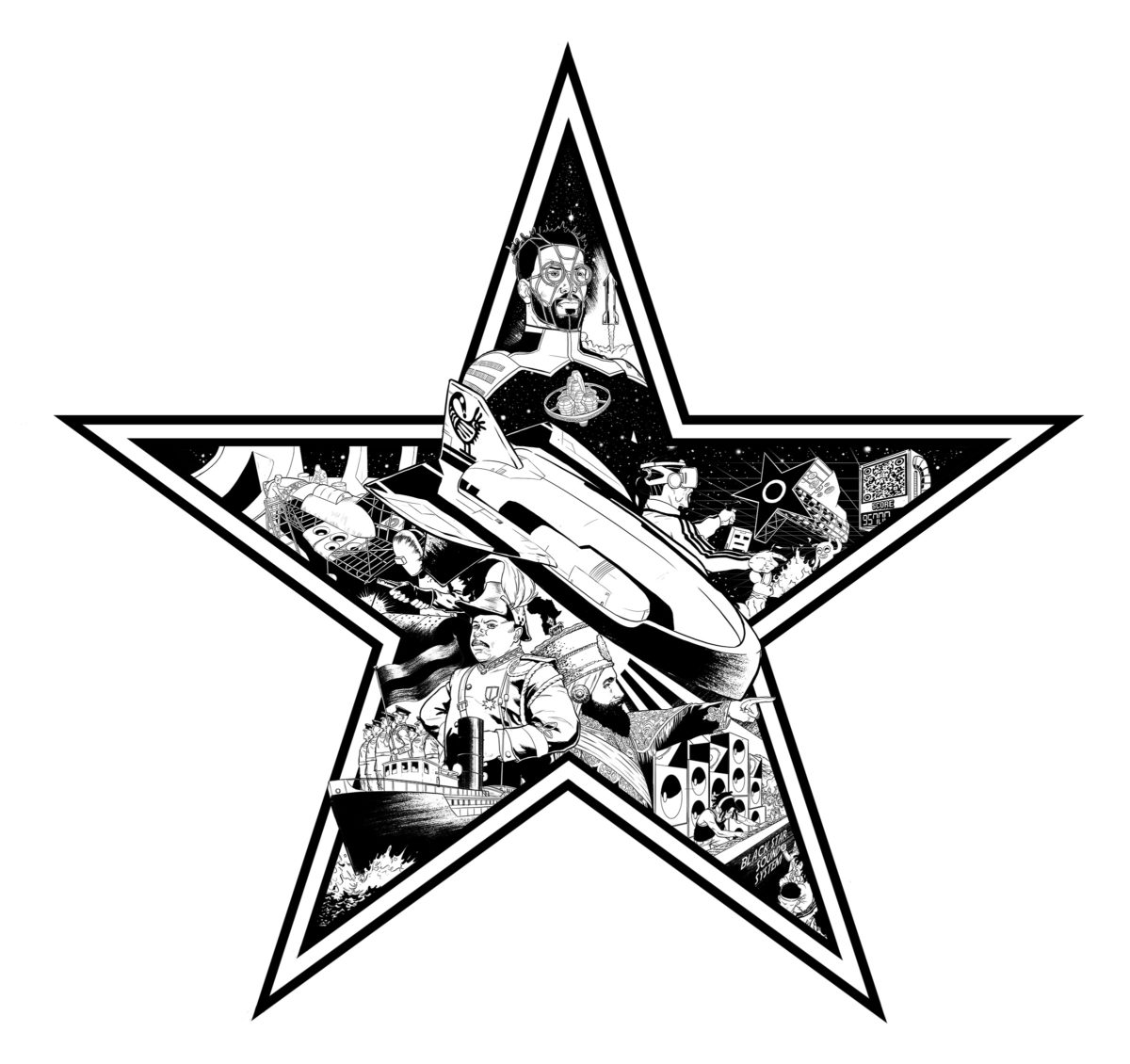
The project tells three key stories about Africa in the world: the story of Marcus Garvey and the Black Star Line; the story of dub music; and the story of Afro- and African Futurism. The first revolves around the creative tactics of an activist ahead of his time, working for the liberation of Africans in the diaspora and on the continent. The second explores the impact of the African diaspora on global popular culture through dub music, which combines African cultural and spiritual forms with electronic sound technologies to create virtual sonic spaces. The third plays on African imaginaries which decolonise the futures predicted by historic global powers. The stories are interconnected, looping through the past, present and future. Like the Sankofa bird in Adinkra symbolism, the project stands in the present, its feet pointing to the future while its head looks to the past. The project emphasises the impact that imagination and stories can have, in carrying liberationary messages to audiences across space and time.
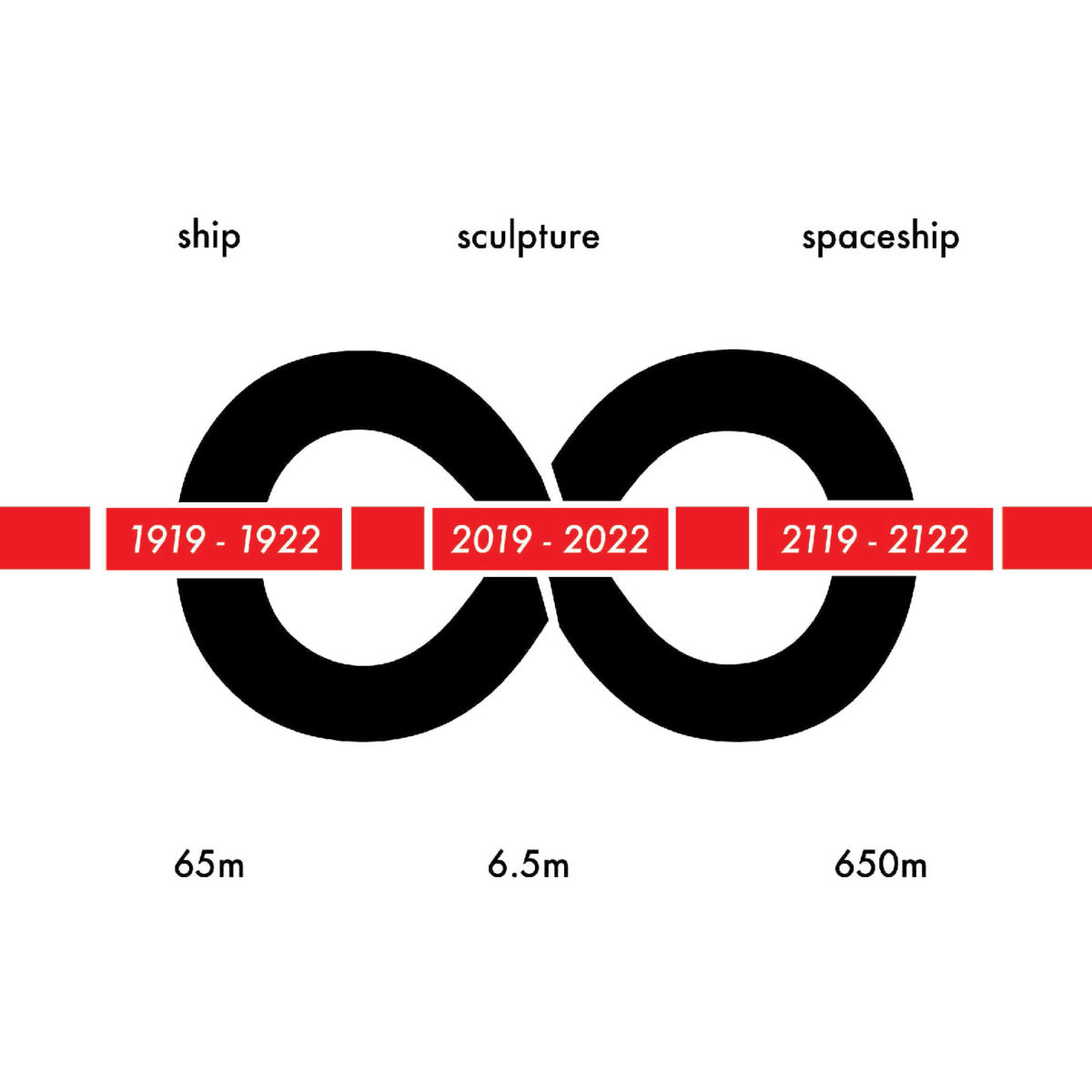
We employ archetypal narrative devices – the mask, music and dance, performance and story-telling – while using an array of exciting new techniques and technologies: VR allows for spectacular use of scale and the expansion and collapse of space and time. Ships and spacecraft can appear in real scale, while whole worlds can be shrunk till they fit in your hand. People can meet each other outside of geographic space. The project intends to experiment with new ways of telling stories with emerging media, drawing on existing approaches from immersive theatre, film and VR experience, while contributing its own. All three stories include the motif of ‘transportation through technology’: the repurposing of technology to express African ends. This is a motif which this project extends, Africanising the Metaverse, telling diverse stories from and beyond the continent.
The team
Ralph Borland is an internationally-exhibited artist, curator and researcher based in Cape Town, South Africa. He grew up in South Africa and Zimbabwe, and studied in the US and Ireland. He majored in Sculpture, and is a graduate of the Interactive Telecommunications Program at New York University. His work often combines art, activism and technology, and digital processes with handcraft. He has been working in the XR space for several years. His projects African Robots and SPACECRAFT are collaborations with street wire artists in Southern Africa that combine African vernacular practices with interactive electronics. The project has been funded by the South African Department of Sports, Arts and Culture, the National Arts Council, Business Arts South Africa, British Council, Pro Helvetia and Africa Culture Fund, demonstrating a successful record for the delivery of work. His research work has focused on the creative and activist ways in which the South negotiates its position in the world. He uses creative processes to investigate the impact of emerging technologies in Africa for HUMA, the Institute for Humanities in Africa, at the University of Cape Town. He is a member of the ‘Afr(io)futurism’ research group at Bayreuth University, and of Metaverse Crew Africa. His work is in public spaces in South Africa, and in the permanent collection of the New York Museum of Modern Art. He presented his work at the International Symposium of Electronic Arts in 2018 and 2019. He was a selected artist on the Dakar Biennial of Contemporary African Art 2022, and his work is currently on show on the exhibition Dig Where You Stand at SCCA Tamale in September – October 2022. Ralph is committed to advancing hybridity in its many forms: in connecting cultures, bridging arts and technology, combining activism with pleasure, and conducting research with practice.
Dara Kell is an award-winning documentary filmmaker and writer based in, born and raised in Cape Town. Her film work focuses on popular political movements as well as the intersection between creativity, censorship and free expression. Her latest film, ‘A Ship from Guantanamo’ is a New York Times OpDoc and recently premiered at the DOC NYC film festival. Her film ‘Dear Mandela’ won top prizes at the Durban International Film Festival and the Brooklyn Film Festival, among others. She is currently making a film about prominent US-based civil rights leader and preacher Reverend Barber as well as a series about artists in exile around the world. She was a video producer at New Frame in Johannesburg, and is studying Visual History and new forms of storytelling at the University of the Western Cape.
Dwayne Kapula is a self taught photographer and multimedia artist based in Johannesburg and Cape Town, born in Zimbabwe to immigrant parents from Malawi and Mozambique. He was introduced to Nyauist traditions for masked performance by his grandfather, which he translates into his contemporary sound art and performance work. His practice involves social experimentation and archiving in the form of installations, objects, visuals, live performances and sound art. He seeks to explore ideas that connect people. “To be human is to have a story” says Dwayne “My homecoming is to revisit some of my early recollections, to gather the missing FRAGMENTS of my identity. Where is Home? Mine is the story of an immigrant – an unsettled/transitory existence, constantly PASSING through BORDERS real and imagined”.
Sean Devonport is a programmer and sound designer focused on immersive audio and immersive media programming. Currently based in Cape Town, he grew up in Johannesburg and was then based in Makhanda, Eastern Cape for 7 years completing his Masters degree. He has worked on numerous South African immersive theatre productions at the National Arts Festival, some which won awards, and some of which were the first multi-speaker (+25 speakers) immersive audio productions in the country. These productions were supported by his Masters research which focused on developing a novel distributed spatial audio processing system. Since then he has worked with South African companies to do amazing things. He is a co-founder of South African-based immersive audio company ‘ImmersiveDSP’, and has worked with Resonate Studio in Cape Town to deploy all the audio systems at the UAE Pavilion at the Dubai 2020 World Expo. This required working with a group of international artists including Zach Lieberman, Matthew Herbert and Nexus Media to implement interactive audio systems that worked with interactive visual systems. He is currently focused on developing a mixed reality product with a South African-based startup called ‘Simulon’. This app is an innovative product which incorporates Unity, Unreal and the cloud to provide a mixed reality tool that creates amazing user-generated content.
Ofentse Letebele aka King Debs is a multimedia artist based in Cape Town, South Afrika. Working primarily in 3D digital art and his self-developed calligraphy, King Debs creates a unique aesthetic to transpose his ideas on identity and Afrikanism. His work deals with with the notion of post-humanism within an Afrikan context. He is inspired by ‘trans-humanist’ ideology and the dystopian convergence of man and machine.
Jason Stapleton works with a range of software including 3D animation, game engines and procedural generation tools. With these he creates abstracted digital worlds in which he seeks to question the boundaries between the virtual and the real. His primary mediums are video, 360 video, game, VR and AR. In these he explores various aspects of digital capture such as photogrammetry, LiDAR and traditional methods. His core interest is in VR, specifically virtual embodiment and how it relates to consciousness in its ability to inform our experience of consensual reality. He has wide experience in the creation of VR social worlds on platforms such as VRC. He is based in Cape Town.
Selected work by Ralph Borland
Dubship I – Black Starliner (2019 – 2022) As covered in the South African Sunday Times newspaper in 2021. The artwork that started it all: a large-scale music-making spaceship sculpture that memorialises the first ship in the Black Star Line shipping company, launched by the political activist Marcus Garvey in 1919. It was produced using African street wire-art techniques, combined with cutting-edge VR sculpting tools, and incorporates an electro-mechanical dub sound system. Exhibited on the Afrofuturist art exhibition ‘Still here tomorrow…‘ at Zeitz MOCAA, at the Dakar Biennial 2022, and on the exhibition Dig Where You Stand at SCCA Tamale 2022. For more info see dubships.spacecraft.africa
African Robots and SPACECRAFT (2013 – ongoing) Adventures in African wire art: this project started with the collaborative production of a small robot bird by the side of the road in Cape Town, South Africa, working with street wire artists from Zimbabwe. Since then the project has been to Mozambique, Zimbabwe, Brazil, Toronto, London and South Korea, and into the Metaverse.
Song of Solomon (2006) An aleatoric audio collage, an 8-channel audio installation that samples many versions of ‘Mbube’, aka ‘Wimoweh’ aka ‘The Lion Sleeps Tonight’, in a sonic tribute to the song’s dead author Solomon Linda. First shown at the National Gallery in Durban, South Africa, it has been exhibited in Vancouver as South Africa’s entry in the Cultural Olympiad, and in Dublin at the Project Art Centre. It recently graced the cover of the book ‘Media Primitivism‘ (2020) on Duke University Press.
Suited for Subversion (2002) A protective-performance suit for protestors that projects the wearer’s heart-beat audibly outside their body, this work has been seen by millions of visitors to the New York Museum of Modern Art, where it forms part of their permanent collection. It grew out of Ralph’s early experience in combining political activism, creative expression, and technology.
Previous XR Content we have created
Some recent XR projects team members have worked on:
Digi-Dub Club is a VRChat world for remote socialisation, and a platform for art and performance, launched 2020 on the Johannesburg Art Fair. An otherworldly desert landscape, containing an animated 3D scan of the sculpture ‘Dubship I – Black Starliner’. Directed by Ralph Borland, made by Jason Stapleton and Sean Devonport. Funded by Africa Culture Fund.
Mycelia World on Raindance Immersive and Venice VR Expanded 2021, winner of the Spirit of Raindance Award 2021. It is both a world to explore and a virtual theater with live dance performances, set to music generated via the bio-sonification of living mycelium. Jason Stapleton and Sean Devonport contributed to this team build.
Bliss in the Ear of a Storm on Venice VR Expanded 2021: a surreal landscape populated with musical instruments. At its centre is a live feed from a neural net generative music piece creating an endless stream of black metal, that has been running since 2019. Jason Stapleton and Sean Devonport contributed to this team build.
The A MAZE Train Station, a VRChat world, for the Goethe Institute Johannesburg, 2020. A monolithic, minimalist train station created to host the A MAZE train jam in response to Covid restrictions (previously it took place on an inter-city train in physical space). Supported and mentored by Eden and Metaverse Crew South Africa. Jason Stapleton and Sean Devonport contributed to this team build.
The Game n Train Mixer in VRChat, for the Goethe Institute, 2021. An endless train journey with each compartment redecorated to show artwork from games created for the A MAZE train jam. Jason Stapleton and Sean Devonport contributed to this team build.
Mountains of Madness, a VRChat world, 2020. An otherworldly landscape populated by interdimensional entities, inspired by H P Lovecraft’s tales. Made by Jason Stapleton and Sean Devonport.